
Filing the taxes on time and accurately is a bit of a challenging task, especially if you are filing Form 1040 for the first time.
What is form 1040
This form is basically used by U.S. citizens and residents for filing an annual income tax return. Apart from this, it is also used to report income to the IRS, calculate tax liability, and identify whether you owe additional taxes or are due a refund.
Herein, this blog contains all the details regarding who can file, different tax forms, schedules, and how to fill out the tax form.
The 1040 form is mainly filed by U.S. taxpayers for filing an annual income tax return. However, the Form 1040-SR is an optional alternative for accessing Form 1040 for taxpayers 65 or older. Besides this, the Form 1040-SR accesses the same schedules and instructions as the Form 140 does. This form is to be filed if your
An image of IRS form 1040 is shown below, which has two pages.
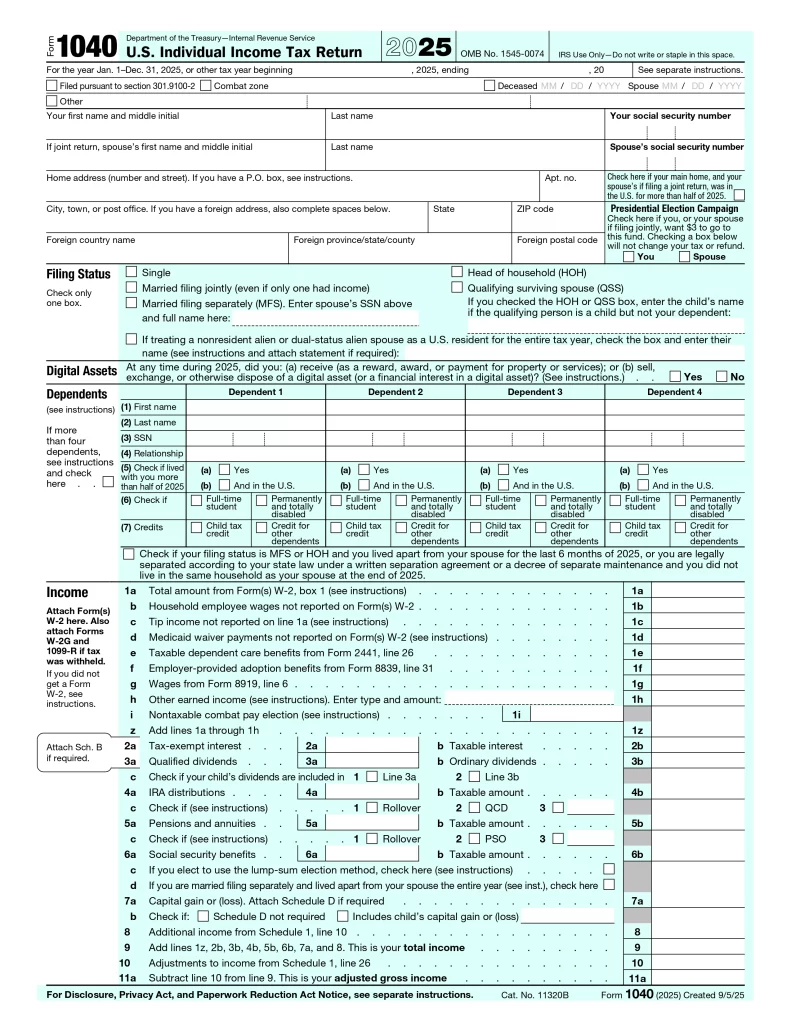
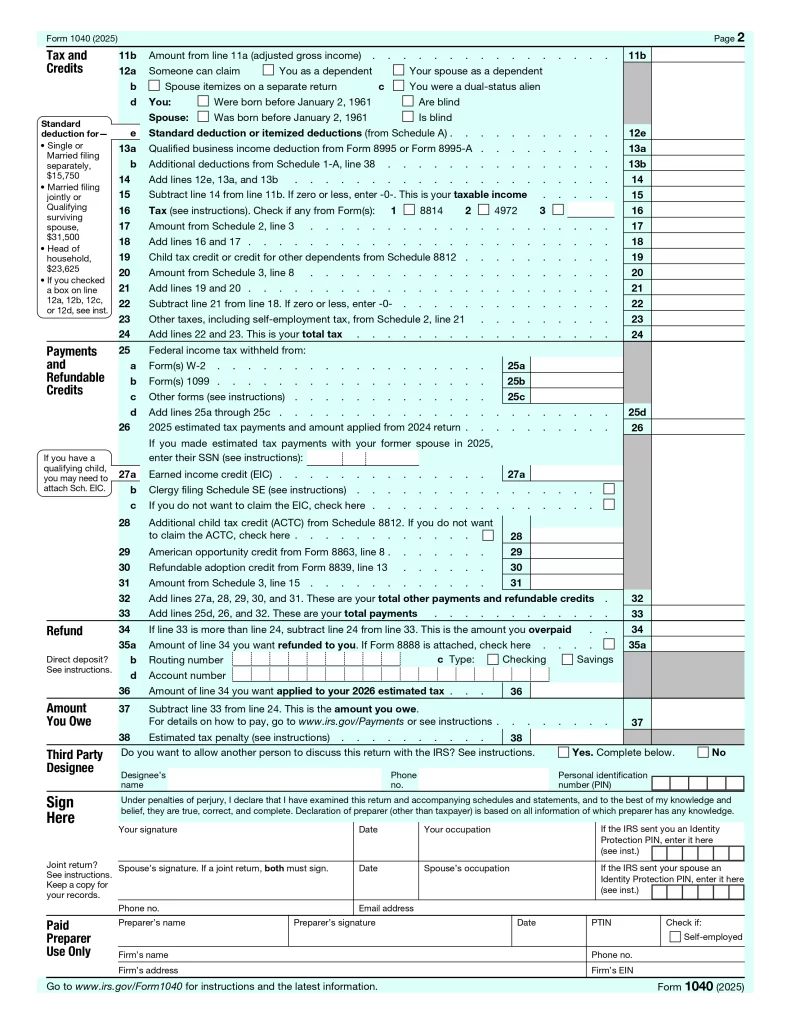
Despite its complex appearance, the form requires a few essential details. Below are the points that this form ask for.
Before filing the 1044 form, you must have the following documents that includes personal details, identification, income documentation and documents for income and credits.
Collect all those forms that report the income you get during the tax year.
You may require certain records when you plan to itemize deductions or claim certain credits.
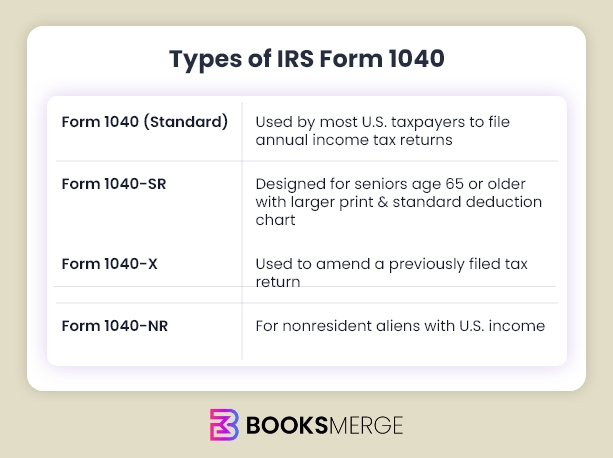
Below, we have discussed the different types of 1040 forms according to your age, income type, or tax situation. It may include Form 1040, 1040-SR, 1040-NR, and 1040-X.
It is the most common form that is used mainly by U.S. taxpayers and covers all filing situations.
It is a special version of a form of the standard 1040 and is for the age group of 65 and older.
This form is to be filed by non-resident citizens who worked or earned money in the U.S. Moreover, this 1040 form consists of the following details:
In case you have made any mistakes on your original tax return, you don’t need to start over; you can file Form 1040-X. This form is also known as the amended 1040 form. You require this form if;
The different schedules that are available for Form 1040 include Schedule A, Schedule B, Schedule C, Schedule D, Schedule E, Schedule F, Schedule H, Schedule J, Schedule R, Schedule SE, and Schedule 8812.
The Schedule A (Form 1040), Itemized Deductions, includes recent updates, related forms, and instructions on how to file.
Schedule B, Interest & Ordinary Dividends, contains the details like recent updates, related forms, and instructions on how to file.
The Schedule C used for Profit or Loss from Business, is required for reporting income or loss from a business operated or profession as a sole proprietor. Also, it consists of recent updates, related forms, and instructions on how to file.
The Schedule D form for capital gains & losses includes recent updates, related forms, and instructions on how to file. Also, it is used for reporting sales, exchanges, or some involuntary conversions of capital assets, certain capital gain distributions, and non-business bad debts.
The Schedule E, Supplemental Income and Loss, consists of recent updates, related forms, and instructions on how to file. Also, this form is used for reporting income received via rental properties, royalties, partnerships, S corporations, estates, trusts, and residual interests in REMICs.
The Schedule F, used for Profit or Loss From Farming, comprises recent updates, related forms, and instructions on how to file. It can be used for reporting farm income and expenses.
The Schedule H, Household Employment Taxes, comprises recent updates, related forms, and instructions on how to file. Also, this form is used by household employers for reporting household employment taxes.
The Schedule J, Income Averaging for Farmers and Fishermen, comprises recent updates, related forms, and instructions on how to file.
The Schedule R form is for the credit for the Elderly or the Disabled, which covers recent updates, related forms, and instructions on how to file. You can use this form to identify the credit for the elderly or the disabled.
The Schedule SE form is for the Self-Employment Tax, which contains recent updates, related forms, and instructions on how to file. Moreover, this form is accessed by self-employed persons to figure the self-employment tax due on net earnings.
The Schedule 8812 for Credits for Qualifying Children and Other Dependents covers Credits for Qualifying Children and Other Dependents. This is used to figure out the additional child tax credit.

For filing out IRS tax form 1040 accurately, you need to go through the step-by-step instructions outlined below.
Before beginning the process, it is essential to have all the mandatory documents and verify the personal details. The following are the documents that you will require:
Important Tip: You must check out the Ssns against the Social Security cards. If there is any incorrect number, it may reject the returns and delay refunds for months. There are many married couples who opt for the Married Filing Jointly for lower tax rates. Whereas the head of household offers better rates than single, but it must be a qualifying dependent.
Herein, you are required to report every source of income that you received throughout 2025 for computing the total income according to these 1040 instructions.
Herein, you must include Box 1 from all the W-2 forms. You can also insert any household employee wages, allocated tips, dependent care benefits, or military combat pay in specialized lines 1b-1h.
If you’re unsure whether your income should be reported as w-2 wages or 1099 contractor income, understanding the difference is critical before filing. see our detailed breakdown of 1099 vs w-2 forms tp avoid misreporting income and IRS penalties.
In this section, you must report the tax-exempt interest from the municipal bonds (lines 2a). Also, it includes taxable interest from banks (Line 2b). Beyond this, you can also report the qualified dividends, which may receive favorable tax treatment (line 3a) and ordinary dividends (line 3b). In case your total interest or dividends are more than $1,500, then you have to attach the Schedule B.
In this column, you must report IRA distributions reflecting both total as well as taxable amounts (Lines 4a- 4b). Also, you may report the pensions and annuity income (Lines 5a-5b), Social Security benefits, along with the total received (Lines 6a). Beyond this, you must mention the taxable portion calculated by accessing the worksheet that might be 0%, 50%, or 85% taxable based on other income (Line 6b).
Herein, you have to mention capital gains or losses from selling stocks, bonds, real estate, or crypto using the Schedule D (Line 7). Also, you need to report if there is any additional income received from Schedule 1, including unemployment, gig economy income, gambling, winnings, or alimony received via pre-2019 divorces (Line 8).
You have to include lines 1z through 8 to compute the total income received before deductions.
Important Tip: Herein, don’t skip to answer the new digit assets; either you have to say yes or no regarding the cryptocurrency and NIFT transactions. The IRS gets the reports from crypto exchanges, so it is necessary to answer accurately.
You can reduce your income by making adjustments and deductions to identify the taxable income according to Form 1040 Instructions 2025.
Herein, you can claim “above-the-line” deductions from Schedule 1 Part II that you receive when taking the standard deduction.
Herein, you need to deduct Line 10 from Line 9. With the help of this crucial number, you can easily identify the eligibility for various tax benefits. If the AGI is lower, it states that there are more available credits and deductions.
For the year 2025, the standard deductions for Singles are $15,750, married and filing jointly $31,500, Head of Household $23,625, and married filing separately $15,750. You need to sum up $2,000 if single/HOH, and for the age group of 65+ blind. Also, sum up $1,600 per person if married and in the age group of 65+ or blind. Itemize if the total deductions comprise medical expenses above 7.5% of AGI, state and local taxes up to $10,000, mortgage interest, and charitable donations.
The self-employed individuals and business owners may deduct up to 20% of qualified business income. You need a Form 8995 or 8995-A for calculation.
Herein, you must add lines 12c and 13.
You need to deduct Line 14 from Line 11. As a result, this amount will identify your tax bracket. You need to insert zero if the result is negative.
Important Tip: You must remember your AGI, and you have to sign it electronically next year.
Compute your tax liability and then reduce it with the available credits using the 1040 instructions.
You must access the tax table if the taxable income falls under the $100,000 or Tax Computation Worksheet if it exceeds $100,000. For the year 2025, federal tax brackets include:

If you are having capital gains, then access the Schedule D Tax Worksheet for preferential taxes.
You need to add special taxes from Schedule 2 if applicable. It also includes Alternative Minimum Tax (AMT), self-employment tax, additional Medicare tax, and Net Investment Income tax.
Herein, sum up Lines 16 and 17.
The credits will eventually reduce the tax dollar-for-dollar, and make them more valuable than deductions:
You need to sum up Lines 19 and 20.
You must deduct Line 21 from Line 18. Herein, insert the zero if the amount is negative.
Rare additional taxes from Schedule 2, which might consist of household taxes.
You must sum up Lines 22 and 23, which is the final tax liability for 2025.
Check whether you have overpaid or underpaid taxes and file your return following the 1040 instructions.
You need to report from Schedule 3 i, i.e., excess Social Security Withheld if you are having multiple jobs, credit for federal tax on fuels, and other refundable credits.
Herein, sum up Lines 25a via 25d and Line 32. It covers everything that you paid to the IRS throughout 2025.
Herein, we have described how to fill out the Form 1044 according to different situations.
It might be a bit challenging for the users to file the Form 1040 for the first time. So, to help you out, you must walkthrough the following steps:
If you are only working as an employer and getting the W-2 form, then do as follows:
If you file a 1099 form or self-employed income, then the steps may vary, as explained below.
The Form 1040-SR is quite similar to the Form 1040, but it is prepared basically for the age group of 65 or older.
In case you are claiming someone as a dependent, then it may hamper your taxes.
At times, certain mistakes made while filing the 1040 form may cause a heavy loss to the taxpayers. So, to file the tax return accurately without any delays, you must take care of the following things.
You have to file the IRS tax form 1040 electronically, either through e-file or IRS Free File. As a result, it minimizes the errors made in tax returns as the software updates regarding any miscalculations on its own.
Another important thing to consider is that you have inserted the accurate name and social security number (SSN) for each dependent you claim. Also, verify that every dependant’s name and SSN match the dependant’s social security number. Furthermore, for every child below age 17 qualifying as a child comes under child tax credit must mark the box in column 4 of the Dependents section.
You need to check your maths, mainly for the child tax credit, earned income credit (EIC), taxable social security benefits, total income, itemized deductions, and taxable income, total tax, federal income tax withheld, and refund or amount you owe.
It is essential that you use the right method to figure out your tax.
The taxpayers must ensure that they enter the correct SSN in the space available on page 1 of Form 1040 or 1040-SR. In case you are married or want to file jointly, provide your spouse’s SSN. Make sure that your name and SSN both agree with your Social Security card.
You must have a look at where you file your return before mailing.
You must verify that you won’t file more than one original return for the same year, even if you receive your refund. This is so because filing multiple tax returns for the same year or sending in numerous copies could delay the refund.
Don’t forget to sign and date Form 1040 or 1040-SR, and also provide your occupation.
Also, it’s essential to attach your W-2 form along with other necessary forms and schedules. You need to attach all the forms along with the schedules in an organized manner.
If you owe tax and are paying via check or money order, it’s crucial to mention all the payment details.
If you are getting the EIC, it’s necessary to check that you are using the correct column of the EIC table for your filing status. Also, verify the number of qualifying children who have a valid SSN.
The taxpayer must provide the correct name and address. Also, provide your spouse’s name in the same manner as shown on the last return.
Check that you and your spouse, with whom you are filing jointly, are enrolled in marketplace coverage, and advance payments must be attached to Form 8962. If there are any excess payments, then you need to repay them if someone else has enrolled you in marketplace coverage, and that individual isn’t claimed as a dependent.
You have the option to file the Form 1040 online or via mail. Below, we have described the procedure for both of them.
Most often, the taxpayers opt for electronically filing the 1040 to get the refund quickly. There are many tax professionals who charge a fee to file the tax return electronically. Even if you prepare the return yourself with tax software, you need to pay a fee for filing the return. But if you wish to qualify for free online filing, then go to Free File.
If you mail a 1040 form, then it may take approximately six weeks for processing. You need to ensure that you attach the following documents:
You don’t have to think much about filing the tax form in the right area when you file the 1040 form electronically. On the other side, if you’re filing a paper return, send it to the address mentioned in the instructions for the form you’re filing.
The tax deadline for filing the Form 1040 is April 15, 2025. You can get the extra time for filing the taxes if:
So, we conclude this post and hope that you can now fill out the form 1040 with confidence. Filling correctly helps you avoid penalties, delays, and unnecessary IRS notices. If you prefer expert help, booksmerge offers affordable tax filling assistance with clear pricing and no hidden fees. Our tax professionals can review your return, handle complex forms, and make sure everything is filed correctly and on time. Check out our pricing plans to find the right option for your tax needs, or just simply call us on +1-866-513-4656
Yes, you can fill out the Form 1040 on your own through the following methods.
Yes, you can file the Form 1040 for free as per your income and tax situation.
In case you made a mistake on Form 1040, then you have to file Form 1040-X to correct the error.
The taxpayers only need to file the additional schedules along with Form 1040 when the tax situation covers income, deductions, or credits that don’t fit on the main form itself.
If you have filed the 1040 form electronically, then the IRS will refund in less than 21 days, especially when accessing the direct deposit form. Whereas, the paper returns may consume more time, i.e, 6 weeks or more.
QuickBooks Assisted Payroll: Features, Subscription, Availability & More
Read More