
This should save you ~10 minutes of reading

You can connect with our BooksMerge experts, who are available 24/7 to assist you with any tax-filing or form-related questions. You may call our experts directly using the +1-866-513-4656 this service is completely free. To schedule a callback, however, you’ll need to log in to your account or create a new one.
S Corporation provide tax savings by dividing owner salary and distributions, whereas LLC are simpler with profits that are subject to self-employment tax. S Corps need payroll and formalities and LLC allow flexible ownership and less compliance, making suitable for startups or small businesses.
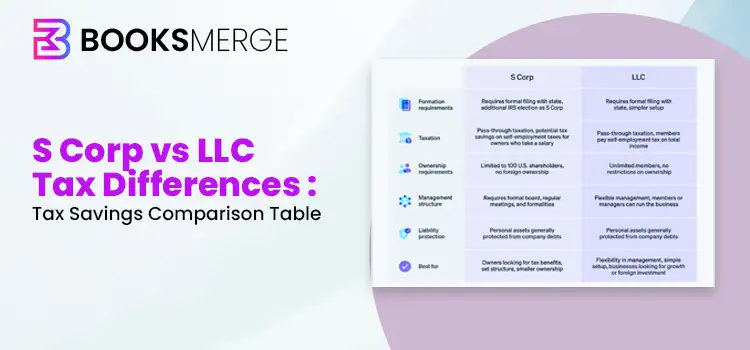
Herein, we have provided the key difference of S Corp Vs LLC.
| Feature | S Corporation (S Corp) | LLC (Limited Liability Company) |
| Structure | A corporation that has elected S Corp status with the IRS. | An uncorporated business structure. |
| Ownership Limit | Maximum up to 100 shareholders. | Unlimited restrictions. |
| Best For | Profitable businesses that requires tax savings. | Startups, small businesses that requires simplicity. |
| Formalities | It is essential to follow corporate formalities including board meetings, bylaws, etc. | It involves fewer formalities giving more flexibility to management structure. |
| Owner Restriction | It can be accessed by U.S. citizens/resident individuals. | No restrictions are imposed. It can be accessed by foreign, corporations, or LLC. |
| Profit Distribution | The profit must be distributed on the basis of ownership percentages. | The profits can be distributed according to the agreed-upon ratio among the members. |
| Self-Employment Tax | This tax is paid on “reasonable salary” not distributions. | It is paid on all net earnings. |
| Taxation | Pass through-taxation; wherein profit & loss is passed to the shareholders. Also, it help reduce the self-employment taxes on distributions. | You can opt for pass-through taxation by default or be taxed as a corporation. Herein, all profits are subject to self-employment taxes if member-managed. |
| Liability Protection | It provides limited liability for shareholders. | It provides limited liability for members. |
Let’s study the difference between S Corp Vs LLC on the basis of tax factor.
| Tax Factor | S Corporation (S Corp) | LLC |
| Self-Employment Tax | The self-employment taxes are paid only on salary not on distributions. | Whereas, the members pay self-employment tax on entire business profit. |
| Payroll Requirements | Owners must pay themselves a reasonable salary. | No salary is required. |
| Federal Tax Treatment | Pass-through taxation (no corporate tax) | Pass-through taxation (no corporate tax) |
S corporations are the corporations that are elected to pass corporate income, losses, deductions and credits directly to shareholders to prevent federal double taxation. Herein, the shareholders of S corp report the flow -through of income and losses on their personal tax returns and assess their tax at individual income tax rates.
It is essential to meet the basic requirements to qualify for S Corporation;
It is advised to select S Corporation over the LLC when your businesses continuously generates high net profits over $40,000- $50,000. Also, choosing the S corp over LLC completely depends upon your situation.
1. When you Want to Save on Self-Employment Taxes
In LLC, all the business profits are subject to self-employment taxes which includes Social Security & Medicare.
With the S Corporation, you can
2. When Your Profits are High Enough to Save on Taxes
If you are earning more than which would be considered as a reasonable salary, then S corporation will help in minimizing self-employment taxes.
3. When you are okay with more paperwork
To qualify for the S Corporation, you must require;
For less paperwork, you can go with the LLC.
4. When you doesn’t require Ownership Flexibility
The S corporations must meets the ownership rules;
A limited liability company (LLC) is a business type which is generated under state law. Every state has its own rules, so to start as a LLC, it’s essential to verify the rules in your state.
The owners of LLC is known as members. In certain states, there are some restrictions on who can be a member. It may include;
The best part of LLC is that there is no limit on members. But, there are most of the states that allow a single-member LLC, which indicates that the business can have only one owner. For having more then one owner, it may involve different rules depending on the state where the company is to be formed.
Following are the scenarios when you must prefer the LLC over the S corporation.
1. When You Want Simplicity
Limited limited company are easier to manage than the S corp. This is so because it usually;
2. When Your Profits are Low & Unstable
If you are running a new business or your net income is lower than ($30,000- $40,000), then it’s best to choose for LLC.
3. When you Require Flexible Ownership
The Limited Liability companies are more flexible than the S corps. This is so because, LLC have;
4. When You Want Flexible Tax Options
An LLC can be taxes as;
Before choosing which corporation is best between S Corp VS LLC, let’s look at the cost comparison. This will help you pick the right company according to your budget and preferences.
| Cost Factor | Limited Liability Company (LLC) | S Corporation (S Corp) |
| Formation Cost | The price is usually lower than ($50-$500 + state fees) | Pricing is higher ($100+state fees, + potential legal fees) |
| Annual Maintenance | The annual fee for reporting is lower. | Annual reports, minutes, formal meetings involves higher annual fee. |
| Tax Filing Cost | Lower. It is filed with personal tax return (Schedule C/E). | Higher. Separate tax return is filed (Form 1120 S) required ($800 – $6000+ annually). |
| Self-Employment Tax | It is paid on All profits. | It is mainly paid on “reasonable salary” (W-2). |
| Payroll Cost | None | Requires high payroll service & taxes including (FICA/FUTA). |
| Accounting/Compliance | Minimal | It is little complex and involves payroll/tax compliance. |
| Compliance Area | LLC | S Corporation |
| State Formation Area | Articles of Organization is required. | Article of Incorporation is required. |
| Corporate Formalities | Less formalities is required in most states. | Corporate formalities is mandatory that involves meetings, minutes, resolutions. |
| Ownership Restrictions | Very Flexible | Strict ownership restrictions |
| Payroll Requirements | Not required (unless it is taxes as S Corp) | Payroll is required if shareholders works in business. |
| Federal Tax Return | Schedule C (single member) or 1065 (multi-member) | Form 1120-S |
| IRS Election Required | No until you are electing for S status | Yes, and for that you may require Form 2253. |
| Reasonable Salary Requirement | No | Yes |
| Stock/Ownership Classes | Flexible profit allocated is allowed | Only one class of stock is allowed. |
Herein, we have provided you with the simple set of instructions to convert an LLC to an S Corp.
First Step: Check the Eligibility
Second Step: Get an Employer Identification Number (EIN) If Not Already Issued
make sure that your LLC must have a valid Employer Identification Number. You can get it from the IRS by completing forms and following proper procedure.
Third Step: File IRS Form 2253
Once you decide to elect as a S Corporation, it’s essential to;
Fourth Step: Update State Requirements (If necessary)
Fifth State: Set Up Payroll For Owners
Sixth Step: Update Accounting & Bookkeeping Practices
Herein, we have described the features of S Corporation and LLC that will help you decide which is best for small business.
LLC: Best For Simplicity & Flexibility
S Corp: Best for Tax Savings on Profits
Before deciding between and S Corporation and an LLC, buisness owners should understand basic tax rules explained in our Small Business Tax Accounting Guide
Following are the common mistakes that the businesses do while taking S Corp Vs LLC decisions.
1. Neglecting Compliance Requirements
Owners underestimate the paperwork required for the S Corporation. Any missing annual meetings, or payroll filings may results in heavy penalties or loss to S Corp status.
2. Not Considering Ownership Flexibility
You are selecting S Corp when you plan to have many or foreign owners.
3. Ignoring State Rules
Many states make mistakes by treating S Corp or LLC the same.
4. Confusing Legal Structure Vs Tax Status
Sometimes the businesses make mistake by considering S Corp a type of business entity like an LLC.
5. Starting as an S Corp Too Early
If the businesses elect the S Corp status from day one without any stable profits.
6. Missing Filing Deadlines
The businesses fails to file the Form 2253 according to the latest IRS guidelines.
7. Neglecting To Verify Your Entity’s Eligibility
It is essential that your clients must know about the S corp eligibility restrictions so that they won’t waste their time on filing for election if their company doesn’t meets the IRS guidelines.
8. Failing to Set Up Payroll-
Business owners must understand about the proper steps to setup payroll along with running the business to pay themselves and other employees.
Because S Corporations require owners to pay themselves a reasonable salary, many businesses rely on Payroll Services for Small Business to stay compliant.
BooksMerge Insight: How We Help Clients Decide Between S Corp vs LLC?
The BooksMerge help the clients in deciding whether to choose S Corp Vs LLC for your business.
1. Tax Savings & Profit Levels-
The businesses earning higher net income, S Corp allow owners to pay themselves and distribute the remaining profits to prevent self-employment tax.
2. Administrative Burden & Costs-
LLC are easy to manage as it involves less formalities. Where, S Corp involves a lot of paperwork, require IRS filings, payroll processing and strict to the IRS guidelines.
3. Ownership Restriction-
S corp are restricted to 100 shareholders that must be a U.S. citizens or residents but doesn’t have another corporations as owner. Whereas, LLC offer more flexibility in ownership, as it invoices complex structures.
4. Liability Protection-
Both the LLC and S Corp provides similar protection that safeguards personal assets from business liabilities.
5. Flexibility-
LLC is more flexible than the S Corp.
Common Question around S Corps and LLC
1. Can an LLC own an S Corp?
An LLC doesn’t own an S Corporation unless it qualifies under certain specific rules.
It is essential that the IRS must fulfill strict ownership requirements. To maintain the S Corp status, make sure that the shareholders must be;
Whereas, the LLC is treated as;
In case the LLC;
In that case the IRS can look through LLC and treat the individual owner as the actual shareholder.
2. Can an S Corp own an LLC?
Yes, an S Corp can own an LLC. When an S Corp own an LLC, then LLC is considered as a separate legal entity and S Corp ownership interest in LLC is treated as business asset. Moreover, the S Corp will report its ownership in the LLC on its tax return. Any income or losses created by LLC will flow through the S Corp and will be reported through the S Corp tax return.
3. Single Member LLC Vs S Corp
| Feature | Single Member LLC (SMLLC) | S Corporation (S Corp) |
| Tax Treatment | Pass Through; It is filed on Schedule C (Form 1040) | Pass-Through; Filed on Form 1120S. |
| Best For | It is best for the low-profit businesses and for the beginners who are seeking for simplicity. | It is suitable for the profitable businesses that focuses on reducing taxes. |
| Setup & Maintenance | It is easy to setup this business and requires less paperwork. | Its is difficult to setup this business and paperwork is complex. |
| Ownership | It can be operated by one member (which can be an individual, LLC, corp) | It can be operated by maximum 100 shareholders (Individuals only, U.S. Residents/citizens). |
| Self-Employment Tax | You need to pay Self-Employment tax on 100% of the net earnings. | You need to pay FICA only on reasonable salary. |
| Payroll Requirement | Payroll is not required. | Payroll is required but reasonable salary is mandatory. |
| Corporate Formalities | Very Less formalities is required. | Corporate formalities is required that involves meetings, minutes, officers. |
| IRS Filings | Schedule C (Form 1040) | Form 1120 – S+ K-1s |
4. Is LLC or S Corp which is best for holding company?
An LLC is considered is a better option than an S Corp for the holding company because of its flexibility, low admin burden. Also, it’s best as it has the ability to hold subsidiaries without S Corps have strict, limited rules on shareholders.
We ensure that by reading this entire post you can easily understand difference between S Corp Vs LLC. Also, it helps you in choosing the right company for your business. If you still require any additional help, then connect with our BooksMerge professionals or call +1-866-513-4656 for quick assistance.
Yes an LLC can be taxes as an S Corp by filing IRS Form 2253 to elect as S Corp status.
An S Corporation makes financial sense if the net business profits reach consistently reach $60,000 to $80,000 or more annually.
No, S Corporation doesn’t pay self-employment tax on business profits distributed to owners.
Yes, the S corporation is better for the high-income earners specifically with net earnings around $50,000 to $100,000.
Yes, you have the option to switch from LLC to an S Corp at a later date after filing IRS Form 2553, “Election by a Small Business Corporation.”
IRS charge penalties on S Corp salary when the shareholder or employee take low salary to prevent payroll taxes. It may include reclassifying distributions as wages, need payment of back taxes (15.3% FICA), interest and penalties up to 25% for failure to pay.
