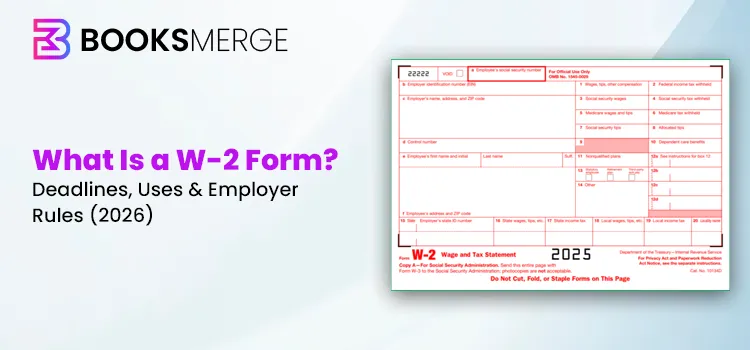
What Is a W-2 Form and Why It Matters in January?
A W-2 Form is also known as a Wage and Tax Statement, which must be issued by employers to employees by January 31, summarizing the total wages earned and taxes withheld from an employee’s paycheck throughout the year.
Article Summary:
• File the Form W-2 when you have one or more employees to whom you make the payment for the employee’s services in your business during 2025.
• Moreover, the employees must get the W-2 form filled out by 31st January each year for reporting an employee’s annual wages and tax withholdings.
• It’s essential to file the W-2 form timely. Any missing, incorrect, or late filing may result in heavy tax penalties.
• Above all, the W-2 form is to be filed by the employer who earns $600 or more throughout the year.
Managing and filing the taxes timely is a bit challenging and time-consuming task that every business has to conduct every tax season. Especially, employers need to send the W-2 form to their employees by January 31st each year. The question might be bothering you what is a W-2 form? It is a Wage and Tax Statement that summarizes an employee’s wages along with the taxes withheld from their paychecks throughout the year.
Moreover, it also includes information on employees’ benefits like health insurance, Medicare, and Social Security. Continue reading this post to know who issues the W-2 form, the deadline, common mistakes, and how to file it accurately.
W-2 is an IRS Form that is issued by the employer to its employee, and it covers the details regarding how much money you earned and taxes withheld from paychecks. Moreover, the W-2 also lets you know how much money is deducted from federal income tax, Social Security, and Medicare taxes. However, it is important that the W-2 form is sent by the employers to employees in January, and one copy of it must be submitted to the IRS.
In this blog section, we have discussed how small businesses and startups, employers with full-time or part-time employees, and first-time payroll filers can issue a W-2 form to their employees.
• Small businesses and startups
The small businesses and the startup companies can issue the W-2 form to any full-time or part-time employee who is receiving income, social security, or Medicare taxes withheld. This form is also issued when they paid $600 or more to the employees in the form of wages, even though no taxes are withheld.
• Employers with full-time or part-time employees
Employers with full-time or part-time employees are obliged to issue a W-2 form to each qualifying employee.
• First-time payroll filers
The first-time payroll filers are obliged to issue a W-2 form depending on the wage amount paid and whether taxes are withheld. It doesn’t depend upon the employer’s filing history. If you’re unsure how to set up payroll correctly or stay compliant from day one, our ultimate guide to payroll services for small buisnesses (2025) explains the entire process in detail.
The W-2 form is an essential document that summarizes an employee’s earnings, tax withholdings, and other benefits. Moreover, this IRS form is also important for various purposes, which we have explained below.
According to the SSA, employers must send the W-2 forms to their employees online by January 31. Along with this, they need to file each employee’s W-2 with the SSA by 31 January. In case the due date of filing the tax return falls on a weekend or a legal holiday, then the filing date will be shifted to the next business day.
For the taxation year 2025, the deadline to file the W-2 form is February 2, 2026, as January 31 falls on Saturday. However, if you couldn’t file the form on time, then you may also ask for an extension of time to file the W-2 form. You can either request a one 30-day extension for filing the Form W-2 by filling the form 8809, i.e, for Application for Extension of Time to File Information Returns.
If you fail to file an accurate W-2 Form by the due date, then you may need to pay the penalty under section 6721. The penalty amount depends on when you file the Form W-2. The penalties will only apply in the following conditions:
• You fail to file timely
• Report a wrong TIN
• Provides incorrect details on Form W-2
• Fails to report a TIN, file paper W-2 forms that are machine-readable.
• File on paper forms when you need to e-file
However, these penalty amounts will apply while filing the taxes after the 31st January 2025.
|
Time Period |
Penalty |
|
File Within 30 days after the due date |
The maximum penalty ranges $683,000 yearly and $239,000 for small business. |
|
File More than 30 Days after the due date but by August 1 |
$2,049,000 yearly and $683,000 for small businesses. |
|
File after August 1 |
$4,098,500 yearly and $1,366,000 for small businesses. |
It is essential that your employers send your W-2 form by the 31st January each year. But, if it’s not received on time, then do according to your situation:
Case 1: When you don’t get a W-2 by the end of January
You must directly get in touch with your employer to get the latest updates regarding when the W-2 form is coming.
Case 2: When you don’t get a W-2 by the end of February
Even after connecting with your employer, you couldn’t get your W-2 or connect at TFN. Right after this, we will connect with your employer and then request a missing W-2. Otherwise, we will provide you with a copy of Form 4852, which you can use to file the tax return without having a W-2 form.
Case 3: When you don’t get a W-2 in time to file taxes
You can access your paycheck stubs to estimate your wages. After this, you can complete the Form 4852 and then attach it to your tax return.
There are numerous mistakes that are made by businesses while completing the Form W-2. Below, we have discussed some of the most common errors that you can avoid, and businesses can save their money by avoiding heavy tax penalties.
1. Inappropriate Employee Data
The employers must ensure that all the data related to their employees mentioned on the form is correct before filing it. This is so because the IRS wants the employee details provided on the form to tally with the details printed on their Social Security cards.
2. Late or Incomplete Filings
It is essential for the employees to receive the W-2 form by their employees at 31st January. Besides this, the employers should also send copies of all employees’ W-2s along with the Form W-3 to the SSA by the 31st January. Otherwise, the late or incomplete filing may result in heavy tax penalties for the businesses.
3. Reporting the Wrong Wages or Taxes
Most often, the W-2 mistakes may occur when the wages, tips, or tax withholdings are not reported correctly. This situation usually happens when the bonuses, commissions, or fringe benefits are handled improperly.
Herein, we have discussed the difference between 1099 Vs W-2.
|
Aspect |
W-2 Form (Employee) |
1099 Form (Independent Contractor) |
|
Purpose |
The W-2 form is mainly used for reporting annual wages and taxes. |
The 1099 Form is used for reporting various types of non-employment income to the IRS and taxpayer. |
|
Benefits |
This tax form is eligible to take the benefits including health insurance, PTO, and retirement plans. |
It doesn’t cover any benefits. Herein, the worker has to cover all the benefits on its own. |
|
Legal Protections |
It is covered as per the labor laws (minimum wage, overtime, anti-discrimination) |
This form isn’t covered under the most of the labor protections. |
|
Work Type |
It supports ongoing, scheduled work that is being directed by employer. |
It supports project-based, short-term, or specialized work. |
|
Tax Burden |
The employee pays off half of the Social Security and Medicare Taxes. |
Herein, the contractor pays for the entire self-employment tax. |
To find out which form to file between W-2 Vs 1099, you must go through the table provided below.
|
Instances |
Right Form |
Why It is Suitable |
|
A receptionist who works 9-5 in office |
W-2 |
This is basically a controlled schedule and tools are offered. |
|
Sales rep with salary + commission |
W-2 |
This one is a continuos role and the role is controlled by payer. |
|
Attorney receives $3000 gross proceeds |
1099-MISC Box 10 |
It states that the legal payments are done above $600 (minimum reporting threshold), even though the firm is incorporated |
|
$250 holiday gift card |
None |
Below $600 and the wages isn’t tied to the working hours. |
|
Freelancer writer receives $1200 |
1099-NEC |
These are the independent contractors who gets above $600 (minimum reporting threshold). |
To fill out the W-2 form correctly, you must perform the following steps.
The employers must complete, or file the W-2 form electronically via the Social Security Administration (SSA), reflecting the wages paid and taxes withheld throughout the year for each employee. It is essential to file the W-2 form accurately and timely, as the employee’s Social Security and Medicare taxes are computed based on the details on the form.
Any person who needs to file the W-2 form must also file the W-3 form to transmit Copy A of Form W-2 to SSA. But, at the time of e-filing the W-2 form with the SSA, you don’t have to file the W-3 form. This is so because the W-2 online service will generate an electronic W-3 form on your behalf.
You can obtain the Form W-2 packet from the official IRS website. However, this form packet consists of six copies, including
You can obtain the address for mailing the copies of Form W-2 and W-3 as mentioned on the IRS website. It is essential that the Form W-3 and Copy A of each W-2 form be sent to SSA, and can be ordered online. You also need a copy of Form W-3 and Form W-2 for keeping the records for at least 4 years.
The W-2 tax form provides a clear picture of your annual earnings and taxes withheld from your paycheck for the year. Beyond this, it also contains the information regarding:
Below, we have listed all the sections that are reported on your W-2 form.
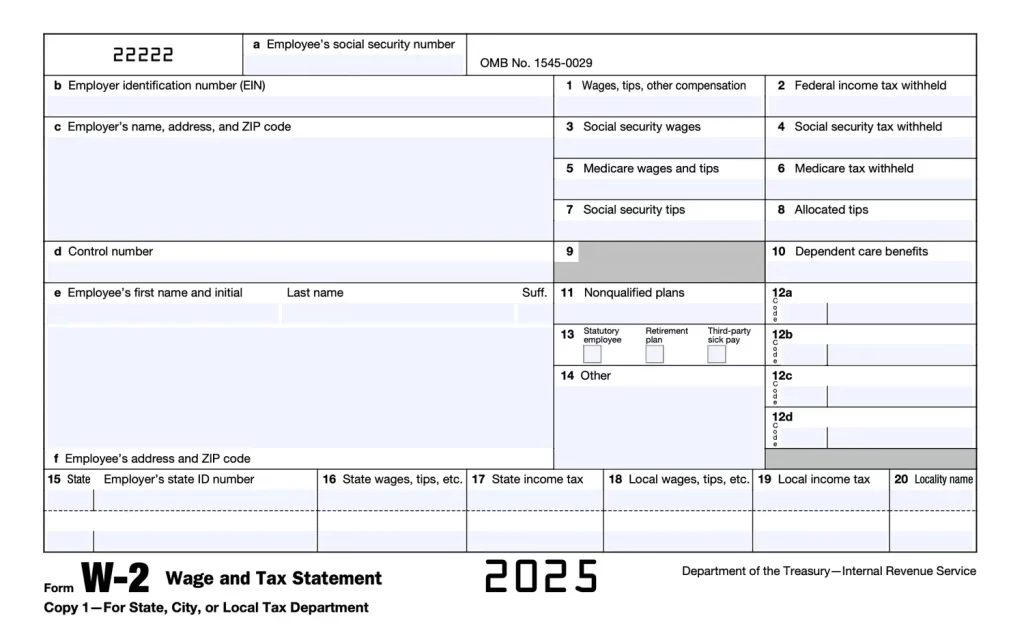
1. Box (A-F): Identifying information:-
On the Box a-f on the W-2 form includes the Employee’s Social Security Number, Employer Identification Number, Employer’s name, address, and ZIP Code. Besides this, it also contains the Control Number, the employee’s first name, and last name.
2. Box (1 and 2): Compensation and Federal Income Tax Withholding:-
Herein, Box 1 represents your taxable income, which comprises wages, salary tips, and bonuses. On the other side, Box 2 indicates how much income for federal income tax the employer withheld.
3. Box (3 to 6): Social Security and Medicare Wages and Tax Withholding:-
The boxes 3 and 5 represent the amount of earnings subject to Social Security and Medicare taxes. Herein, boxes 4 and 6 represent the amount of Social Security and Medicare taxes withheld from your pay throughout the year.
You may notice that the amount mentioned in Boxes 3 and 5 may slightly vary from the one that reflects in Box 1. This situation usually happens where taxes on some of your income are deferred.
4. Boxes 7 and 8 (Tips):-
In case you earned money by tips you received throughout the year, then Box 7 will reflect how much you reported in tips. The box 8 represents how much money your employer has given to you as a tip.
5. Box 9 – Reserved:-
This box shows the amount of an employer benefit that is not available any longer (advance earned income credit payments). So, presently, this box will now be grayed out as a result.
6. Box 10- Dependent Care Benefits:-
The Box 10 basically shows how much an employee gets from their employer in dependent care benefits (if any applicable).
7. Box 11- Non-qualified Plans:-
Box 11 shows how much deferred compensation you get from the employer in a non-qualified plan.
8. Box 12- Codes:-
The Box 12 basically reflects other types of compensation or reduction from taxable income. Also, it includes the one-or two-letter code. This section also contains contributions to a 401(k) plan, or the sick pay you get via a third-party (such as an insurance company).
9. Box 13- Statutory Employee, Retirement Plan, and Third-Party Sick Pay:-
The Box 13 basically represents whether you have worked as a statutory employee, which isn’t subject to federal income tax withholding. If you have participated in an employer-sponsored retirement plan (including a 401 (k) plan). Also, it includes the sick pay you receive through a third-party (like an insurance company).
10. Box 14- Other Information:-
On Box 14 of the W-2 form, an employer reports any additional tax details that don’t go in any other section. It may include state disability insurance taxes and union dues.
11. Boxes 15-20- State & Local Information:-
The Box 15-20 is mainly used for reporting state and local income tax information, which includes the employer’s state ID number (allotted by the state). Also, it includes local wages and withholding of state and local income taxes.
When you find any errors on an employee’s W-2 Form after sending it to them to SSA, you need to submit a Form W-2C, which is basically for the Corrected Wage and Tax Statement. Also, you must insert the Form W-3C, Transmittal of Corrected Wage and Tax Statements, every time you file a Form W-2c via mail to the SSA. However, you can also make the Form W-2C corrections electronically on the Form W-2 filed via Business Services Online.
Below, we have provided you with a comparison table illustrating how 1099-NEC is different from the W-2 form.
|
Feature |
1099-NEC Form (Contractor) |
W-2 Form (Employee) |
|
Worker Type |
If you are working as an independent contractor or freelancer, the company will send you a 1099-NEC form. |
If you are working as an employee, then you will get a W-2 form. |
|
Filing Deadline |
You need to file this form by 31st January each year. |
You need to file this form by 31st January each year. |
|
Tax Withholdings |
None of the taxes withhold. |
It includes tax withholding for the federal, state and FICA. |
|
Tax Responsibility |
Herein, the contractor has to pay self-employment and income tax. |
Employer withhold taxes and employee have to pays the balance. |
|
Control/Direction |
High autonomy and the contractor works according to its own method. |
Supervised. Herein, the employer has the full control over the work, when and how it needs to be performed. |
|
Reporting Trigger |
This form is to be filed if you are earning more or 600 per year. |
This form is filed when you are paid in the form of wages or compensation. |
Below, we have elaborated the major difference between a W-4 form and a W-2 form.
|
Feature |
W-4 Form |
W-2 Form |
|
Purpose |
This form informs the employer how much tax to withhold. |
This form is used for reporting yearly earnings and taxes withheld. |
|
Who Prepares This Form |
If you work as an employee, you prepare W-4 form to give it to your employer. |
This form is prepared by your employer after the tax year and then it is send to their employees and SSA. |
|
Reports |
Provides the information which you employer uses to identify how much tax to withhold from paycheck. |
This form is used ro report how much you earned from an employer and how much income you withheld from pay during the year. |
|
Usage |
The W-4 form directs payroll withholding. |
It is mainly used to file the federal or state tax returns. |
|
Focus |
This taxation form majorly focuses on future tax payments. |
This taxation form majorly focuses on past tax payments. |
|
When Filed |
The W-4 form is to filed at the time of hiring or when personal/tax situation changes. |
It is essential that the W-2 Form is to filed by 31st January each year. |
|
Completed By |
Employee |
Employer |
The Form W-2 G is filed to report gambling winnings and any federal income tax withheld on those winnings. However, the requirements for reporting and withholding depend upon the following factors:
It is essential that you file the W-2 G form via mail by 31st January of the following year. This form basically represents how much you won at the payer’s establishment. In case you get multiple W-2G forms, then you need to include all those winnings at the time of preparing the tax return.
The Cafeteria 125 on a W-2 is an employee benefit plan created by the IRS. This form enables the employees to set aside pre-tax income for certain benefits provided by the employer, including accident and health insurance, dependent care assistance, adoption assistance, and group term life insurance policies. Moreover, it is named as a Cafeteria plan because employees are being offered numerous benefits, which are quite similar to a cafeteria-style menu.
The employers must send the W-2 form to their employees by the end of 31st January each year. In case the deadline falls on any weekend or legal holiday, then you must get it filed by the next business day.
In case you haven’t received the form by early February, connect with your employer immediately, verify your address, and then ask for a copy. After that, if you can’t get the form, connect with the IRS for guidance.
So, we ensure that this post have helped you understand what is a W-2 form, who must issue, filing deadline, mistakes and how to overcome it. Thus, it will help the employers in filing the taxes accurately with the IRS by 31st January each year without any delays. Furthermore, if you still need any tax professional help with W-2 filing and payroll compliance, you must dial the 1+866-513-4656 or visit Booksmerge for further assistant.
If you are having an employee who is paid at least $600 throughout the year, then your employer needs to send a W-2 form for the year.
You can get your W-2, i.e., Wage and Tax Statement, mailed to your home address or routed to your department for distribution purposes. It must be done by January 31 each year, and if you don’t receive it by the due date, you must connect with your Personnel/Payroll Office.
The following pre-tax deductions are made from the W2 income that consists of life insurance, disability insurance, health insurance, and 401(k) contributions.
To compute your W-2, you must perform the following steps:
• Look for your Gross Income and then subtract pre-tax deductions.
• After this, subtract the non-taxable income.
• At last, compute your annual taxes (Local, State, and Federal Income withheld and Social Security & Medicare.
Yes, the IRS can easily catch a missing W-2 since your employer also needs to report it. It is essential to provide all your W-2s when you file a tax return. In case the IRS rejects your tax return if you forget to file a W-2, then you need to file an amendment.
It is essential that employers send the W-2 form to their employees by 31st January.
