
Tax season can be stressful, but it’s important to know about the tax deadlines 2026 in advance helps you avoid penalties, interest, and last-minute panic. The last date to file the tax deadline is 15th April 2026.
Most of the taxpayers didn’t know about the quarterly payment due in January, the W-2 their employer had to send by January 31, or the IRA contribution window that closes the same day they file. However, one missed date can cause loss of hundreds of dollars in penalties, which are completely avoidable.
In this write-up, we have covered everything you need to stay compliant and ahead of schedule. You’ll find key federal filing dates, quarterly estimated tax deadlines for freelancers & self-employed individuals, important deadlines for different business entities, and an overview of state-level variations. We’ll also explain what happens if you miss a deadline and how to recover quickly.
|
Date |
What’s Due |
|
January 15, 2026 |
Q4 2025 estimated tax payment |
|
January 31, 2026 |
W-2s and 1099s sent to recipients |
|
April 15, 2026 |
Tax day- file, pay, extension request, IRA/HSA contributions |
|
June 15, 2026 |
Q2 2026 estimated tax payment |
|
September 15, 2026 |
Q3 2026 estimated tax payment |
|
October 15, 2026 |
Extended filing deadlines |
This guide is for you if you are:
The business tax returns are due on the 15th day of the third or fourth month of the company’s year. If this due date falls on any weekend or holiday, the due date is moved to the next business day. Whereas for the partnerships and S corporations, the last date for filing taxes is March 15.
Below, we have mentioned other tax deadlines for individual filers.
January Tax Deadlines 2026:
|
January 15, 2026 |
The estimated due date for the tax payment is in 4th Quarter 2025. Also, if you are a self-employed or have other income without any tax withholding, then this is the due date for final quarterly payment for the 2025 tax year |
|
January 26, 2026 |
This is the due date when the IRS starts accepting and processing federal tax returns for the 2025 tax year. |
February Tax Deadlines 2026:
|
February 2, 2026 |
This is the due date for employers to send W-2 forms. Also, it is essential that W-2 form must be sent by 31st January, but you it’s not important that you get this form by this date. |
|
February 2, 2026 |
If January 31st Falls on a weekend or holiday then the 1099 forms including 1099-NEC, 1099-MISC or 1099-K forms must be sent by the following business day. Received both a w-2 and 1099 this year? Here’s exactly how they affect your taxes differently- 1099 vs w-2: What’s the difference and why it matters |
|
February 16, 2026 |
If you opt to claim for an exemption from your employer withholding taxes from your paycheck last year by filing W-4 form, refile the form by this date. |
April Tax Deadlines 2026 (The Most Important Date):
|
April 1, 2026 |
If you have turned 73 in 2025, you have due date until April 1, 2026 to take your 2025 required minimum distribution from your retirement accounts. |
|
April 15, 2026 |
This is mainly the tax deadline date which falls on 15th April each year. But, it can only be delayed if it comes on a weekend or holiday. |
|
April 15, 2026 |
It is also the deadline for filing Form 4648. Also, it’s the last date to request for an extension to file an individual income tax return. In case you fails to file your taxes by the tax day, be ready to complete an extension request. This will grant you the ability to delay filing a completed return until October 15, 2026. But, even after filing for an extension, you need to pay any taxes you may owe by the April deadline. |
|
April 15, 2026 |
It is the last date to make IRA & HSA Contributions for 2025 tax year. For the individual tax filers, it is also marked as a final day to make contributions for the previous year. |
|
April 15, 2026 |
The first quarter of 2026 is for estimated tax payment due. |
Ready To file but not sure how to complete your return? Follow our step-by-step walkthrough- How to Fill Out Form 1040: Complete guide
June, September, and October Deadlines:
|
June 15, 2026 |
This is the second quarter for estimated tax payment due. The due date basically reflects an equal quarterly share of your estimated income tax liability. The first payment falls in three and a half months into the year, second quarter is five and a half months. The fourth payment is due 12 and a half months after the year starts (typically January 15 of the following year). |
|
September 15, 2026 |
It is the third quarter 2026 which is the due date for estimated tax payment. |
|
October 15, 2026 |
This is the deadline to file your extended 2025 tax return. If you select for extension of tax return, it’s also the due date for filing your tax return. |
In this section, you will learn about the Quarterly Estimated Tax Deadlines 2026 in detail.
You can make estimated tax payments for the current tax year if you fulfill both conditions.
There are some special rules for taxpayers who get their income from farming and fishing, for certain household employers, and certain higher-income taxpayers. Also, whose previous year’s tax return is covered for less than 12 months, and non-resident aliens.
The due date for filing the quarterly estimated taxes is divided into four payment periods. Each period includes a specific payment due date. If you don’t have enough tax by the due date, you may be charged a penalty even if you are due a refund while filing an income tax return at the end of the year.
|
Payment Period |
Due Date |
|
Jan 1- March 31 |
(April 15) |
|
April 1- May 31 |
(June 15) |
|
June 1 – Aug 31 |
(Sept 15) |
|
Sept 1 – Dec 31 |
(Jan 15) of the following year. |
Important Tip: If the due date for making an estimated tax payment falls on a weekend, or legal holiday, the payment will be on time if you make it on the next day that’s not a Saturday, Sunday, or legal holiday.
To prevent the IRS underpayment penalties, it is essential for the taxpayers to meet safe harbor rules by paying atleast 90% of the current year’s tax liability or 100% of the prior year’s tax.
You can prevent the Underpayment of Estimated Tax by Individuals penalty if;
The IRS asks the taxpayers to check into their options to prevent these penalties.
The Form 1040-ES is used to figure out and pay your estimated tax. Estimated tax is a method that helps to pay tax on income that isn’t subject to withholding.
Who Must File?
The taxpayers who owe $100 or more in taxes for the year. Corporations that owe $500 or more.
Quarterly Payments
The tax payments are generally due on April 15th, June 15th, Sept 15th, and Jan 15th of the following year.
Perform the stepwise instructions to use Form 1040-ES.
1. Make Payments- Online- You can use the IRS Direct Pay or the Electronic Federal Tax Payment System (EFTPS).
2. Mail- You may send a check or money order along with the payment voucher.
If your income is irregular during the year, for example, because you operate your business on a seasonal basis or have a large capital gain late in the year, you can either lower or eliminate the amount of multiple installments by accessing the annualized income installment method.
If you want to use the annualized income installment method
To figure out the penalty, perform the following steps.
Each period includes the amounts from the previous periods.
Below we have provided the tax deadlines 2026 according to the entity type.
For the 2025 taxation year (filing in 2026), S corporations and partnerships have to file federal tax returns by 16th March 2026. For filing the taxes, you must use the Form 1120-S or Form 1065. A six-month extension (Form 7004) moves the deadline to 15th Sep 2026.
For the C Corporations, the tax deadline is April 15th 2026. However, corporations can file for a 6-month extension, shifting the deadline to 15th October, 2026.
The tax deadline for sole proprietors and single-member LLCs is April 15th, 2026. If April 15 falls on a weekend or a holiday, the deadline will be shifted to the next business day.
The tax deadline for a multi-member LLC is March 16th, 2026. An extension to request by filing Form 7000 by this date extends until September 15, 2026.
For the financial year (2025-26), the tax deadline for non-profits is July 31st 2026. Whereas, non-profits requiring an audit must file by October 31, 2026.
For the calendar year, businesses extend their tax deadlines for partnerships/S-Corps to September 15th, and C-Corporation/LLC deadlines extend to October 15.
|
Entity Type |
Tax Form Filed |
Filing Deadline (2026) |
Extension Deadline (2026) |
|
Partnership |
Form 1065 |
March 16, 2026 |
September 15, 2026 |
|
S Corporation |
Form 1120-S |
March 16, 2026 |
September 15, 2026 |
|
C Corporation |
Form 1120 |
April 15, 2026 |
October 15, 2026 |
|
Sole Proprietor |
Form 1040 (Schedule C) |
April 15, 2026 |
October 15, 2026 |
|
Single-Member LLC |
Form 1040 (Schedule C) |
April 15, 2026 |
October 15, 2026 |
|
Multi-Member LLC |
Form 1065 |
March 16, 2026 |
September 15, 2026 |
|
LLC (S Corp Taxed) |
Form 1120-S |
March 16, 2026 |
September 15, 2026 |
|
LLC (C Corp Taxed) |
Form 1120 |
April 15, 2026 |
October 15, 2026 |
Not Sure whether your business should be structured as an S-Corp or LLC before the March 16 deadline hits? The tax implications are very different- S-Corp vs LLC: Tax Differences and savings comparison
Which are the States With No Income Tax in 2026?
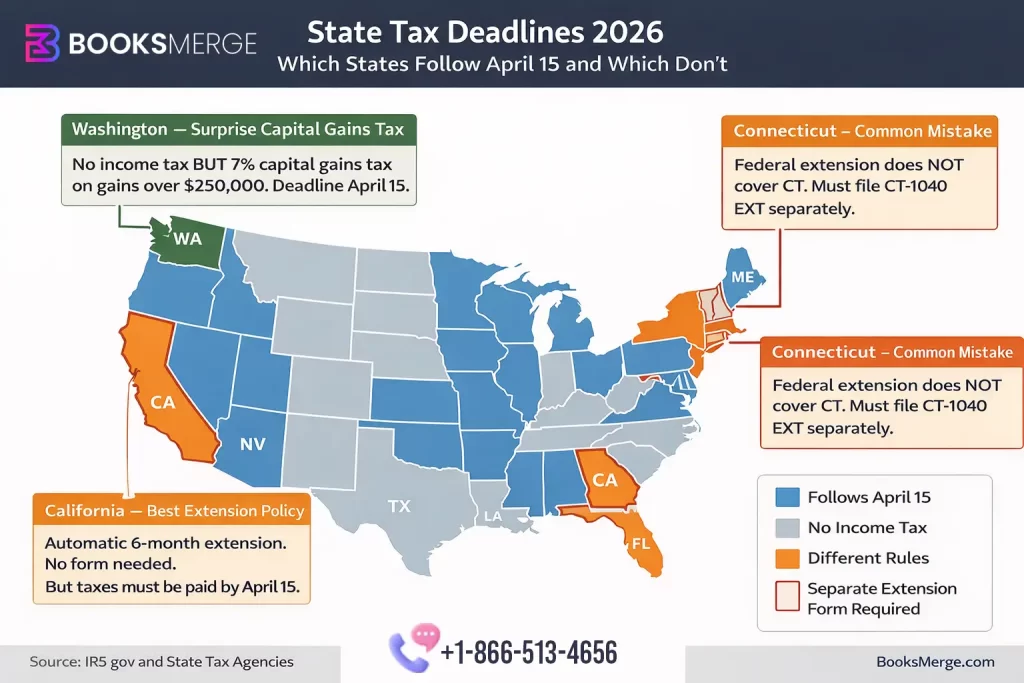
The following are the states having no income tax in 2026. This is because these states depend on higher sales taxes, property taxes, or other fees to generate revenue, with Tennessee and Texas having high average local tax rates.
Which are the States With Different Deadlines or Rules?
• States with Extended 2026 Income Tax Deadlines
Most of the states follow the due date of filing taxes on April 15th, 2026, but the following are the states that offer extra time or have different due dates for individual income tax returns.
|
Oklahoma |
April 20, 2026 |
|
Hawaii |
April 21, 2026 |
|
Delaware, lowa, New Mexico |
April 30, 2026 |
|
South Carolina, Virginia |
May 1, 2026 |
|
Louisiana |
May 15, 2026 |
Federal Extension-
States such as California, New Jersey, and Illinois allow filing extensions until October 15, 2026, if the tax paid is due on April 15.
No Extension Honored
New York, Massachusetts, and Pennsylvania often need payment by April 15, even when the Federal extension is filed.
Sales Tax Deadlines
Most of the states require sales tax reports by the 20th of the month, but exceptions exist.
California gives an automatic 6-month extension for filing state income tax returns, and it moves the deadline from April 15 to October 15, 2026, without having a separate form. This extension is only applicable to filing; taxes owed must be paid by April 15 to prevent penalties.
Important Considerations For California Automatic Extension
The following are the important points to consider for the California Automatic Extension.
• No Need for Extension Form
California extends the filing deadline for its taxpayers by six months, until October 15.
• Payment Deadline Unchanged
It’s essential to pay taxes owed by April 15, 2026, to prevent interest and late payment penalties.
How to Pay:
If you owe any money, it’s necessary to pay it by the April deadline using FTB’s Web Pay or Form 3519 (Payment For Automatic Extension).
• Penalty Avoidance
To avoid the tax penalties, make sure that 90% of your tax liability is paid by the original April deadline.
• Federal Extensions
California doesn’t need to file a federal extension to get the state extension, but doing so is a standard practice.
If you are filing taxes in Connecticut, ensure that you don’t assume your federal extension automatically applies to your state return. In Connecticut, a federal extension is filed with the Internal Revenue Service.
Washington State Capital Gains Tax Deadline 2026
The Washington State Capital Gains applies to qualifying long-term capital gains, and its deadline is April 15, 2026. The tax rate is 7%, which is applied to the sale of long-term capital assets crossing $250,000, with specific exemptions aligning with federal filing deadlines.
You can file the tax returns electronically via the Washington Department of Revenue (DOR) My DOR portal. If a federal extension is filed, the state deadline is automatically extended. However, payments are still due by the original April 15 deadline to avoid penalties.
The following are the states that require separate extension forms.
1. California (Form 3519)- It won’t automatically accept a federal extension. You need Form 3519 while paying by check or online via FTB.
2. Alabama- It doesn’t accept federal extensions. But you need a separate extension if payment is owed, using the Form 40V.
3. Arkansas- You require Form AR1055-IT if you are not filing for a federal extension.
4. District of Columbia- Doesn’t accept federal extensions. But you need a Form FR-130.
5. New York- Need a separate extension, which is filed via the Online Services Account.
6. Arizona- You may require Form 204 if a payment is being made.
Failure-to-File Penalty (The Expensive One)
The failure to file penalty applies when you haven’t filed your tax return by its due date (including extensions).
If you’re a business owner who needs to file 1099s, don’t risk the penalties. See our step-by-step checklist- How to File 1099 Forms Year- End Without Fines
How do you know you owe the penalty?
The IRS will send you a notice or a letter if you owe the failure-to-file penalty.
Penalty Amount
The failure to file penalty amount depends on the tax return type you are filing.
Individuals and Most Business tax returns
The penalty charged will be 5% of the tax due (less any tax paid on time and available credits) for each month or partial month if the tax return is late. However, if the tax return is late by more than 60 days, the minimum penalty amount is the amount listed below or 100% of the underpayment, whichever is less.
|
Return due date (without extension) |
Minimum Penalty |
|
After 12/31/2025 |
$525.00 |
|
01/01/2025 to 12/31/2025 |
$510.00 |
|
01/01/2024 to 12/31/2024 |
$485.00 |
|
01/01/2023 to 12/31/2023 |
$450.00 |
|
01/01/2020 to 12/31/2022 |
$435.00 |
|
01/01/2018 to 12/31/2019 |
$210.00 |
|
01/01/2016 to 12/31/2017 |
$205.00 |
|
01/01/2009 to 12/31/2015 |
$135.00 |
Partnership Returns (Forms 1065/1066/8985)
The penalty amount is charged for each month (or partial month), and the failure will continue up to 12 months.
|
Return Due Date (without extension) |
Base Penalty rate |
|
After 12/31/2025 |
$255.00 |
|
01/01/2025 to 12/31/2025 |
$245.00 |
|
01/01/2024 to 12/31/2024 |
$235.00 |
|
01/01/2023 to 12/31/2023 |
$220.00 |
|
01/01/2021 to 12/31/2022 |
$210.00 |
|
01/01/2020 to 12/31/2020 |
$205.00 |
|
01/01/2018 to 12/31/2019 |
$200.00 |
|
01/01/2010 to 12/31/2017 |
$195.00 |
S Corporation Returns (Form 1120-S)
The tax penalty is charged on each month, and the failure to pay continues for up to 12 months.
|
Return Due Date (without extension) |
Base Penalty rate |
|
After 12/31/2025 |
$255.00 |
|
01/01/2025 to 12/31/2025 |
$245.00 |
|
01/01/2024 to 12/31/2024 |
$235.00 |
|
01/01/2023 to 12/31/2023 |
$220.00 |
|
01/01/2021 to 12/31/2022 |
$210.00 |
|
01/01/2020 to 12/31/2020 |
$205.00 |
|
01/01/2018 to 12/31/2019 |
$200.00 |
|
01/01/2010 to 12/31/2017 |
$195.00 |
Failure-to-Pay Penalty
The IRS computes the failure to pay penalty based on whether you;
Case 1: Fail to pay the amount shown as tax on your return
If the taxpayer won’t pay the tax amount as shown on the tax return, the failure to pay penalty is calculated in the following manner.
Case 2: Failure to pay the tax you didn’t report on your return
The penalty is computed in the following manner: when you fail to pay the tax you didn’t report on your return.
If both the failure to pay and the failure to file penalties are applied in the same month, then the failure to file penalty will be minimized by the amount of the failure to pay penalty applied in that month. For example, instead of 5% failure to file penalty for the month, the IRS will impose a 4.5% failure to file penalty and a 0.5% failure to pay penalty.
The unpaid income taxes for the financial year (2025-26) are charged up to 1% per month or a part of the month starting from the due date.
Key Interest & Penalty Provisions
1. Section 234A Interest- 1% monthly or a part of a month on unpaid tax that is applied from the due date until payment.
2. Late Filing Penalty (ITR)- You need to pay a penalty of ₹1,000 for returns filed after the due date, i.e., 31st July, but before 31st December of the assessment year.
3. TDS Non-Deposit- Interest is charged up to 1.5% if the TDS is deducted but not deposited by the due date.
4. Advance Tax Penalty- The interest is applicable under 234/234C if the advance tax payments are not made as per the schedule.
Consider that you owe the IRS $5000, and you have not filed your tax return or paid by 15th April 2026.
• Failure to File Penalty (5% per month)-
IRS charges up to 5% of the unpaid tax for each month or a part of a month the return is late, up to 25%.
• Failure to Pay Penalty (0.5%)-
If you fail to pay the taxes, then a penalty of 0.5% monthly is added. However, if both penalties are applied, the failure to file penalty is reduced by the failure to pay penalty. This means that the total combined penalty is roughly around 5% per month.
• Interest (around 7% annually)-
Interest begins from April 16, and it will continue unless the bill is paid, which acts as a silent multiplier.
Penalty Relief by administrative waiver
An administrative waiver offers relief from certain penalties under certain conditions. The first time abate is one of the most common administrative waivers for both individuals and businesses.
How to Qualify for First-Time Abate?
You can easily get the first-time abatement for a penalty if you have a history of good tax compliance.
History of Good Tax Compliance
The taxpayer is considered to have good tax compliance if;
First Time Abate relief and unpaid tax
You can request the first-time abate relief even if you haven’t fully paid your tax return. The penalty amount will continue to increase unless you pay the tax in full.
How to request First Time Abate?
You must carry on with the instructions provided in the IRS notice you received.
There are some penalty relief requests that can be accepted over the call. The contact number is provided at the top right corner of the notice or letter you get from the IRS.
If you can’t call, send a written statement or Form 843, Claim for Refund and Request for Abatement.
If you request reasonable cause relief but the IRS records show that you qualify for First-Time Abate, you can apply for First-Time rebate.
If you missed the tax deadline, then file a belated return asap through the income tax e-filing portal. The following are the steps that you must take immediately when you miss the tax deadline.
1. File a Belated Return-
Under Section 139 (4), taxpayers can file the Income Tax Return (ITR) after the due date but before 31st December of that assessment year.
2. Pay Outstanding Tax-
If you owe taxes, pay them instantly, as late filing penalties and interest under Section 234A are applicable.
3. Check Penalties (Section 234F)-
• Income > Rs. 5 Lakh: A penalty of Rs. 5,000 applies.
• Income Rs. 5 Lakh: A maximum penalty of Rs. 1,000 applies.
• Income Rs. 2.5 Lakh: No penalty is usually levied.
4. File An Updated Return-
If you have missed the 31st December deadline, you can file the updated return within two years from the end of the relevant assessment year.
What Is Form 4868 and How to File It?
Form 4868 is filed by U.S. citizens or residents to request an automatic extension of time to file a U.S. individual income tax return. However, this form doesn’t extend the time to pay any gift and GST Tax you owe for 2025.
How to file the Form 4868?
Following are the different ways through which you can file the Form 4868.
1. File a Paper Form 4868:
If you want to file on paper instead of electronically, fill in the Form 4868 and then mail it to the address provided under Where to File a Paper Form 4868 later.
2. E-Filing Using Tax Software or Via Tax Professional
You must contact your tax software package or tax preparer for ways to file electronically. While filing, be ready with a copy of your 2024 tax return. This is required as you may be asked to provide information from the return for taxpayer verification. If you want to make a payment, you can make it later on.
3. Pay Electronically-
If you make the payment using your electronic payment options, then you don’t need to file Form 4868. The IRS will automatically process an extension of time for filing while paying as a part or all of your estimated income tax electronically. Alternatively, you may also pay online or by phone.
Want a deeper breakdown of every extension deadline by filer type? See our dedicated guide- Tax Extension Deadline: Everything You Need to Know
|
Feature |
Extension to File (Form 4868) |
Extension to Pay |
|
Purpose |
It will provide 6 extra months for the submission of tax return forms. |
It grants extra time for sending money owed to the IRS. |
|
Extension to Pay |
This isn’t extension to pay. |
This requires a separate agreement (payment plan). |
|
Due Date |
The filing deadline extends from April 15 to October 15. |
Taxes are due till April 15. |
|
Penalties |
Avoids Failure to file penalty (5% of unpaid tax/month) |
It won’t avoid penalties if it’s not paid until April 15. |
|
Interest |
Interest accrued on unpaid tax from April 15. |
Interest accrued on unpaid tax. |
|
How to Request |
You can file the Form 4868 by 15th April. |
You can apply for a payment plan or pay as much as possible. |
For estimating the amount of taxes you owe for the year, subtract the total tax withheld from your paycheck and estimated tax payments from the amount of tax you owe.
Before estimating the tax liability, make sure to minimize your income by all exemptions and deductions you anticipate claiming. After that, you can estimate the tax you owe using the tax table.
Business Extension Forms — Form 7004 and Form 8868
Form 7004-
The Form 7004 is used to request an automatic 6-month extension for filing certain business income tax, information, and other returns. It is necessary to submit this form on or before the due date of the tax return.
Form 8868-
This taxation form is used by an exempt organization, a government entity, or a trustee of a trust to file the Form 1041-A or Form 5527 to request an automatic 6-month extension of filing taxes. Also, it is used by a Form 5530 filer for requesting a 6-month extension to file a return for excise taxes.
The IRS is providing automatic tax filing and payment extensions until March 30, May 1, and later in 2026 for disaster area automatic extensions. The following are the extension deadlines for the disaster area.
The Military Personnel stationed outside the U.S./ Puerto Rico get an automatic 2-month extension for filing their tax return and paying federal income tax if they are U.S. citizens or resident aliens.
The following are the Military Overseas Tax Extension Rules
1. Automatic 2-Month Extension- If your duty is stationed outside the U.S. and Puerto Rico, the deadline to file taxes is 15th April. This deadline is extended up to 15th June.
2. Extension to File Form 4868- If you want more time for filing taxes, you can request an additional 4-month extension by filing Form 4868.
3. Combat Zone Extension (180 Days)- Personnel in a designated combat zone or the contingency operation receive an extension up to 180 days.
4. Joint Returns- If your spouse is serving in a combat zone, taxpayers can file a joint return that covers the extended deadline.
5. Combining Extensions- If you are staying outside the U.S. but not within the combat zone, combine the automatic 2-month extension with a 4-month extension to receive extra time.
Meeting the 2026 tax deadlines is crucial for taxpayers to avoid late penalties. So, get ready and mark the date 15th April 2026 in your calendar for individual filings, and ensure all income documentation is in hand before submitting to prevent costly amendments. We hope this guide has provided you with the necessary information to make your tax filing process smoother and more efficient.
If you need further assistance, our team of tax professionals at BooksMerge or call us at +1-866-513-4656 is here to help simplify your tax filing experience.

The tax deadline for 2026 is 15th April 2026.
If you miss the April 15th tax deadline, you have to face a failure-to-pay penalty and failure to pay penalty.
Yes, you can get an automatic six-month extension for filing a federal tax return without paying any penalty by filing Form 4868.
The last date for contributing to an IRA for the 2025 year is 15th April 2026.
The quarterly taxes due in 2026 are;
• 1st quarter: April 15, 2026
• 2nd quarter: June 15, 2026
• 3rd quarter: September 15, 2026
• 4th quarter: January 15, 2027
No, not all states follow the April 15 tax deadline. There are several states that have later deadlines, and some of them have no state income tax at all.
No, there isn’t any penalty for filing a late tax return if you owed a refund. Penalties and interest are only applied to unpaid taxes.
You have three years from the original due date of the 2025 tax return for filing the taxes and claiming a refund.
The federal tax deadline for 2026 is October 15th, 2026.
You have to file IRS Form 7004 to request a 6-month file extension.
QuickBooks Install Diagnostic Tool: How to Download, Run, and Fix Install Errors
Read More
AI-triaged.
Human-solved.
Instant QuickBooks diagnostics, then a certified ProAdvisor takes over live.
first-call fix
match time
live coverage